Sewage Odor Removal and Sanitizing
A sewage smell doesn’t always mean sewage is in your house. Sometimes it’s sewer gas escaping through a dry drain or a bad seal, which is a plumbing fix. Other times it’s contamination hidden under a floor, inside a wall or in a crawl space, which needs cleanup. Here’s how to tell them apart.
Please stay on the line while your call connects.
Common sources of a sewage smell
| Source | Clue | Who fixes it |
|---|---|---|
| Dry P-trap in a rarely used drain (guest shower, floor drain) | Smell near one drain; goes away after running water | You: run water for a minute |
| Failing toilet wax ring | Smell around the base of a toilet; possible stains | Plumber |
| Blocked or cracked vent stack | Smell in several rooms, gurgling drains | Plumber |
| Leak under the house or in a wall | Smell worse when water runs; damp spots; insects | Plumber for the pipe, then cleanup |
| Leftover contamination after a past backup or overflow | Smell in the room where it happened, returns in humid weather | Cleanup |
For a step-by-step way to track down the source yourself, see sewer smell in the house but no backup.
When a smell means hidden contamination
If the smell returns after you’ve run water through every drain, is strongest near where a backup or overflow once happened, or comes from under the house, sewage has likely soaked into something you can’t see: carpet pad, the subfloor, the bottom of a wall or crawl space insulation. Air fresheners and surface cleaning won’t fix it, because the source is still there. If the smell comes from below a pier-and-beam house, see crawl space sewage cleanup.
How odor removal works
- Find the source. Moisture meters and close inspection narrow down where the contamination is. Sometimes flooring or drywall has to be opened to confirm.
- Remove it. Contaminated materials are removed, as described on the restoration page. No deodorizer works while the source remains.
- Clean and disinfect. Exposed surfaces are cleaned and treated with an EPA-registered disinfectant.
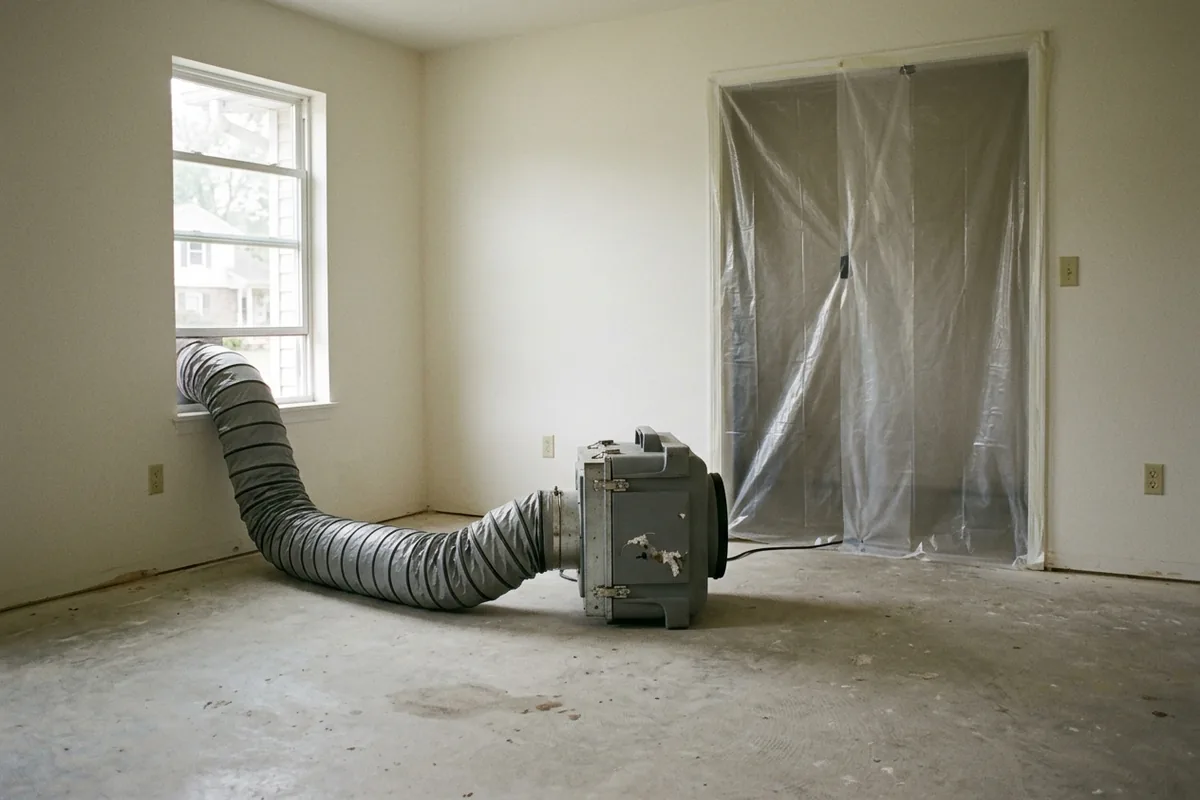
- Treat the air. HEPA air filtration, and in some cases hydroxyl or ozone treatment, deal with odor that has settled into the room. Ozone is only used in unoccupied spaces.
Service area
Sewage odor tracing and treatment is available for homes and businesses across ZIP codes 75087 and 75032: Rockwall, Heath, the parts of Fate inside these ZIP codes, and McLendon-Chisholm.
Odor questions
Is sewer gas dangerous?
Sewer gas includes hydrogen sulfide, which smells like rotten eggs. Low levels from a dry trap are mainly unpleasant, but a strong or persistent smell should be fixed promptly. If anyone feels unwell, ventilate and leave the area.
Why does the smell come back when it’s humid?
Contaminated materials release more odor when they absorb moisture from the air, so a smell that returns in humid weather points to something left behind.
Can I just use an ozone machine?
Ozone can irritate lungs and should not be used with people or pets present. It also won’t fix the smell if contaminated material is still there.
Sewage in your home or business?
Keep people and pets away from the affected area and avoid touching anything wet. Call Rockwall Sewage Solutions at (972) 630-3491 to talk through next steps.
Please stay on the line while your call connects.